Mutual Funds Marketplace

PRODUCTS
The Mutual Fund Marketplace:
More Funds = More Opportunities
The IBKR Advantage
- + Funds available to residents worldwide
- + Funds with no transaction fees
- Other funds available at low commissions and no custody fees
- IBKR is neutral – no proprietary funds
- Free Mutual Fund Search tool to help you find the right funds
- Rated Best Online Broker for Mutual Funds by Benzinga
No Custody Fees and Low, Transparent Commissions on Mutual Funds
Inside the US: The lesser of USD 14.95 or 3% of trade value
Outside the US: EUR 4.95 or currency equivalent






+ Mutual Funds from over fund families
IBKR has one of the largest Mutual Fund Marketplaces, with funds from Allianz, American Funds, BlackRock, Fidelity, Franklin Templeton, Invesco, MFS, PIMCO, Vanguard and many others. In addition, the Marketplace is neutral – there is no conflict of interest as we don’t offer proprietary funds.
- + funds from over fund families
- + with no transaction fees
- Available to residents worldwide
Free Mutual Fund
Search Tool
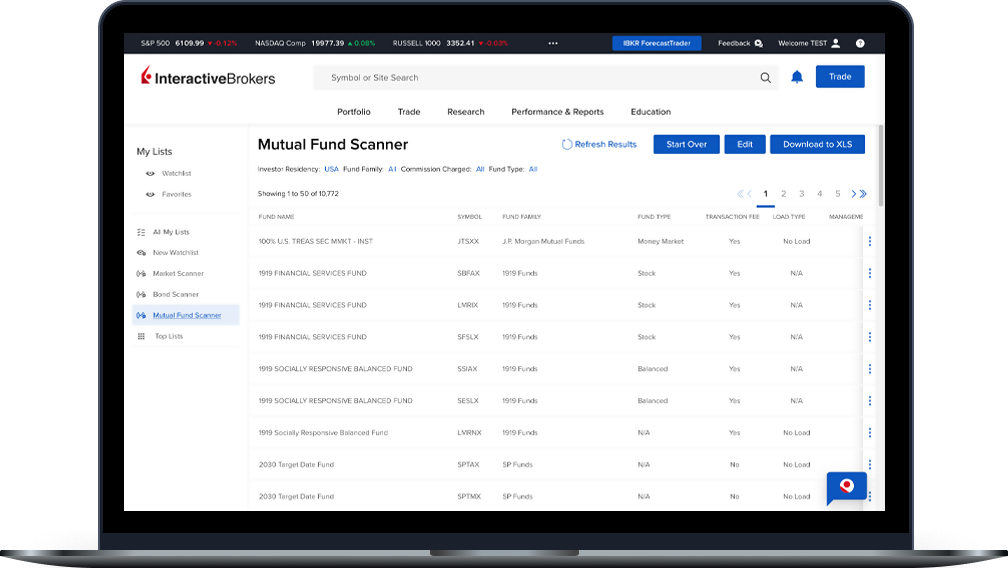
Use our Mutual Fund Inventory Search Tool to identify funds by country of your residence, commission charged, fund type or fund family.


What Are Mutual Funds?
Mutual funds are investment vehicles that pool money from many investors to buy a diversified portfolio of stocks, bonds or other securities.

A mutual fund typically holds a wide variety of securities within and/or across sectors, helping reduce the impact of any single asset’s performance on the overall fund. Each investor in the fund owns a share of the fund, which represents a proportion of the fund’s holdings.
Mutual funds are professionally managed by a fund manager who makes decisions on behalf of the investors. Funds can be actively managed, where fund manager attempts generate fund performance that outperforms a specific benchmark such as the S&P 500, or passively managed, where the fund manager seeks to match the performance of a specific benchmark such as the Dow Jones Industrial Average.
Most mutual funds charge a management fee. Some may be “no load,” which means they do not charge a sales commission or fee when you buy or sell shares, while others may have additional charges like sales loads or redemption fees.
How Do You Buy Mutual Funds?
You can buy mutual funds through several common methods:
Brokerage Accounts
Most online brokerages, including Interactive Brokers, let you purchase mutual funds directly. You can browse available funds, place an order to buy shares, and manage your investments all in one place.
Directly from Fund Companies
Many mutual fund providers allow you to open an account on their website and buy their funds without a middleman.
Through Financial Advisors
If you work with an advisor or financial planner, they can recommend and purchase mutual funds on your behalf.
Employer-Sponsored Retirement Plans
Many 401(k) or similar plans offer mutual funds as investment options, and you can allocate your contributions accordingly.
When buying mutual funds, you will usually need to meet a minimum investment amount, which varies by fund. Purchases are processed at the fund’s net asset value (NAV) price, which is calculated at the end of each trading day.
What Are the Benefits and Risks of Mutual Funds?
Investing in mutual funds offers the benefit of professional management and diversification, which can help reduce the risk associated with individual securities. However, mutual funds are still subject to market risk, meaning the value of your investment can go down depending on overall market conditions. Additionally, fees and expenses can reduce your returns over time. While mutual funds provide a convenient way to access a broad range of investments, it is important to understand that they do not guarantee profits and investors can lose money.

Interactive Brokers’ Education and Resources for Mutual Funds
Traders' Academy
Traders’ Academy by Interactive Brokers provides complimentary resources to educate you on stocks, including an introductory course on Mutual Funds.
Mutual Fund Search Tool
Interactive Brokers offers access to over 50,000 mutual funds from over 500 fund families, including more than 20,000 funds with no transaction fees. Our Mutual Fund Search Tool makes searching this extensive inventory straightforward. Search parameters include region, fund family, minimum or maximum initial investment, transaction fees, and fund type.

Start trading like a professional today!
Disclosures